
Dietary Fats and Body Composition
Published February 2026
Educational Note: This article explains scientific concepts about dietary fats and metabolism. It is not personalised advice. Consult a healthcare professional for guidance related to your individual situation.
Introduction
Dietary fats are often subject to misconceptions, with some believing they directly become body fat or contribute uniquely to weight gain. The scientific reality is more nuanced. Fats are essential macronutrients with distinct metabolic properties, and the relationship between dietary fat intake and body composition depends on overall energy balance and other factors. Understanding the science provides context for evaluating claims about dietary fat.
Types of Dietary Fats
Saturated Fats
Saturated fats are solid at room temperature and are found in animal products, coconut oil, and palm oil. They have been extensively studied for their metabolic and health effects.
Unsaturated Fats
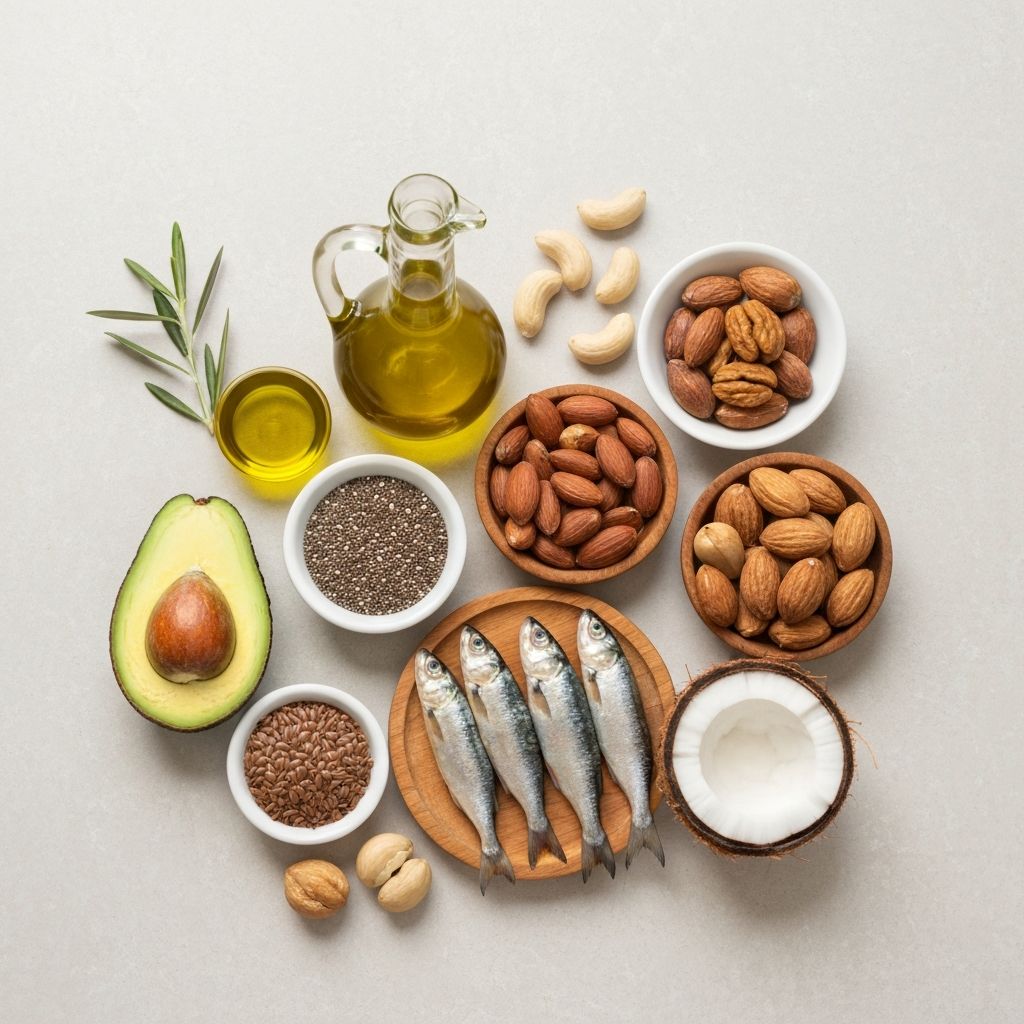
Unsaturated fats are liquid at room temperature. Monounsaturated fats (olive oil, avocados, nuts) and polyunsaturated fats (fish oils, seed oils) are the primary types.
Trans Fats
Trans fats are artificially created through hydrogenation or occur naturally in small amounts in some animal products. Their production and consumption have been heavily restricted in many countries due to health concerns.
The Myth of "Dietary Fat Becomes Body Fat"
A common misconception is that eating fat directly becomes body fat. The reality is more complex. The body preferentially oxidises (burns) carbohydrates and protein based on what was recently consumed, storing dietary fat more readily as body fat when overall energy is in surplus. However, body fat is also mobilised and oxidised continuously. The relationship between dietary fat intake and body fat gain depends primarily on total energy balance rather than fat intake alone.
Fat's Essential Roles
Beyond energy provision, dietary fats are essential for:
- Hormone Production: Including steroid hormones and signalling molecules.
- Cell Membrane Function: Supporting cellular structure and function.
- Nutrient Absorption: Fat-soluble vitamins (A, D, E, K) require dietary fat for absorption.
- Inflammation Regulation: Omega-3 and omega-6 polyunsaturated fats influence inflammatory processes.
- Neurological Function: Supporting brain structure and function.
Fat Oxidation and Energy Density
Fats have 9 calories per gram, compared to 4 calories per gram for carbohydrates and protein. This higher energy density means that fat contributes more calories per unit weight, which is relevant when considering energy balance. However, this doesn't mean dietary fat is uniquely fattening—what matters for body composition is total energy intake.
Fat and Satiety
Dietary fat can contribute to satiety, though the effect is not universally greater than for protein or high-fibre carbohydrates. Fat slows gastric emptying and provides lubrication and taste sensations that influence eating patterns. However, individual responses vary significantly.
Dietary Patterns and Fat Intake
Different populations and dietary patterns incorporate varying amounts and types of fat. Mediterranean diets emphasise olive oil and other unsaturated fats. Other traditional diets incorporate animal fats alongside vegetables and whole foods. The common thread in health-associated dietary patterns is not low fat intake specifically, but overall food quality and consistency.
Metabolic Effects of Different Fat Types
Different fatty acid types have distinct metabolic and physiological effects. However, the evidence that specific fat types directly prevent or cause weight gain is limited. Overall energy balance remains the primary determinant of body composition change.
Conclusion
Dietary fats are essential macronutrients with important metabolic and physiological roles. Common myths about dietary fat causing weight gain reflect oversimplifications of complex metabolic processes. Body composition is determined primarily by energy balance, not by dietary fat intake specifically. Different types of fats have different metabolic properties, but the relationship between any specific fat type and body composition remains influenced by overall nutritional context and energy balance.